Dad’s Cane
Is this what it means to be old? I thought.
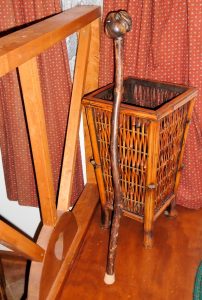
Get up, old man, and show me that you are still alive. Okay, okay, if you must wear the heavy flannel shirt at least roll up the sleeves. Don’t cross your legs like that, at the knee, like an old woman, but spread them wide as you did years ago when you hunched forward and told stories that kept us begging for more even as we, your offspring, clutched each other because your stories were scary. Must you rest your hands on your cane like that, one crossed on the other? Oh, that cane. It’s not really a cane at all but a stout limb from one of the trees. I remember when you found it in the woods behind the house, how you brought it home and stripped away the bark and polished it until it glistened and then you put it away until age demanded you lean upon it. Don’t die on me, old man, for you still have much to tell me.
And he watched as Honey brought his rocks. “What’s this one called, Grandpa?”
“Well, let’s see. That black shiny stuff running through it is called mica. And the white stuff that sparkles in the sun is quartz. And the pink is granite. I forget what the yellow is. Maybe fool’s gold.”
“Mica, quartz, fool’s gold. What’s granite?”
“Comes from the ground. Takes millions of years to get made. Bring me the rock book and we’ll read all about them.”
Skipping, running, he followed her with his sky-blue eyes. Then they left her and rested on the woods, and he singled out the opening in them where he used to feed the cattle in winter. He could still make it out and if he looked hard enough he could see the Herefords attacking the bales with their horns, throwing the loose hay into the air, anxious to get to the sweet middle. Eventually they would eat what they had first cast aside, but that was later in the day when the inside was gone. He could see the calves, too, jumping behind their mothers, kicking up their hooves, and butting each other with their tiny horns. The cattle were gone now. He was too old to take care of them. Too old to take off hay and stock the mow with winter bales. A breeze told him to unroll the shirtsleeves.
“Here, Grandpa. Read.”
Get up, old man. There’s work to be done. Or if you don’t want to work right now, well then, just sharpen the mower blade so it will be ready when you want to cut the fields. No? Not now? Well, maybe later. Please don’t fall asleep again. I just got here. Talk to me. Old man, I know you hear me. You always hear me. Where’s your cap? I don’t know. Wherever you left it. The cattle? You know they’re gone. They’ve been gone for two years. I know the barn’s in good shape, but the cows are gone. It’s okay. Cry.
“Read.”
“It says here granite was melted rock that hardened way beneath the earth and after a million years or so, it’s taken from the ground and…”
“Maybe read later.” Honey skipped away to find Granny and follow her around. “Grandpa’s old, isn’t he?” she asked.
“Not that old, but he’s ill. Remember when he went to the hospital and you couldn’t see him for a week?”
“Yes. Is he sick now?”
“Yes, but we’ll talk about that later. Let’s see if any of the radishes are ready to pick.”
Dad watched as his wife of forty years held Honey’s hand and they walked to the garden. Every year for as long as he could recall, she planted the garden in the same spot. He tried to tell her the ground would yield more if she gave it a rest and planted the garden elsewhere, but he couldn’t tell her anything. So every spring he plowed up the same earth and put compost on it and the rich black fertilizer of long dead cows made the earth yield bountiful crops. So he guessed she was right about that, too.
They were on their knees now, Mom and Honey, searching for radishes, pulling up fat red ones and brushing them free of soil. Mom’s chestnut hair was gray now. She was thin, too, much thinner than last year. Her green eyes had settled deep into their sockets. Still, Dad saw her as the young bride and gentle taskmaster she had always been, intent upon monitoring his activities. She was more cautious now. More thoughtful of him lest he do too much and cause his heart to fail. He shifted in the hard chair. Skip, the cat, nuzzled his ankles. He reached down and scratched its head. Skip took this gesture as an invitation and jumped on his lap. He lost hold of the cane. It clattered on the porch.
“You okay?” Mom yelled. “You okay?” She left Honey and ran from the garden.
“Of course I’m okay.” He wrenched from the hand that tried to help him. He grabbed the cane and winced as the arthritic legs bit him. Then ignoring her clucking, he hobbled to the garden. She told him to be careful. “It’s too hot out there,” she yelled. “Get back on the porch.” She was to his back and he could not, would not hear. “You’ll kill yourself in that hot sun. Do you hear me? Come back on the porch. Come back.” Honey skipped off and joined him.
“I found a blueberry, Grandpa,” she said as she handed it to him. “Here.” She placed the tiny berry in the hollow of his hand. “And here’s another one. Look. And here’s two more. I’ve found a good patch.” She knelt in the middle of it. He watched as the squashed berries stained her white shorts. “Look over here. Lots of them.” She pushed the bushes every which way to get to the fruit. “Look.” She handed him five tiny berries, three with the tips still green. “I did good, didn’t I?” He kissed her cheek.
That’s right, old man. Kiss the young one. Feel the love that flows from her life to yours. Know that she is part of you and when you die she will remain. And what’s that I see? Another tear? Twice today? Tears from the eyes that have been dry all my life? Well, it’s okay. It’s not a bad thing to cry. But it’s too hot, so best mind Mom and get out of the sun.
“You did good,” he said and took the berries and slipped them in his mouth. The child watched him chew. She gave him more. He ate all she offered, even the green ones. Even the stems that mingled with the fruit. “Good,” he said. She wrapped her arms around his swollen knees. He patted her head. They walked back to the garden toward the pea patch. “Only blossoms on most of them,” he said. “But soon they’ll be ready. See that tiny pod forming at the tip of the blossom? Soon we’ll be shelling peas on the porch and your grandmother will be yelling at us, telling us not to eat too many.”
“Granny yells a lot.”
I watched them walk through the garden, examining beans, tomatoes, onions, corn, beets, and carrots. I watched and wondered why he had never taken my hand and walked with me through the gardens of my youth. Watched and wondered if he were walking with me now through my child. Watched and wondered when he had started walking so slowly. Mom sat next to me on the porch swing. I could feel her fear. “Too hot for him to be anywhere but on the porch. Get back here,” she yelled.
“The cows are gone,” he told Honey.
“I know.”
“The sun’s hot.”
“I like it. Can we go to the beach?”
“Not today.”
A breeze stirred.
“Why not?”
A breeze stirred and the corn silks waved.
“It’s too hot.”
A breeze stirred and the corn silks waved and he felt pain in his chest.
Get out of the sun, old man. When did your hair turn white? When did you become thin? I don’t remember you being so thin or your shoulders being so bony or your chest so small. I thought you were taller. When did you lose your height? And that scar over your right eye. Is that the one you got when you were splitting wood and a chip flew and lodged in your eyebrow? Those green workman’s pants. The plaid flannel shirts. Slippers? No steel toe boots? Get out of the sun, old man.
“But I want to go to the beach. Why can’t we go, Grandpa?”
“Get back here. My God, Kate,” Mom says. “He’s walking towards the woods. Come back. Come back.”
And he felt his chest sear with white hot flames and it felt good. He walked faster, throwing away the cane and soaring towards the trees. He could hear now and his legs felt fine and his eyes were clear and he saw her face before him and those of his children and he was flying now and the pain was nothing compared to the freedom it gave him. And he drank in the hot summer air as he felt the heat grow in his chest and he thought he heard someone calling him, but then the heat was upon him and he gave himself to it until it burned out and was replaced by peaceful drops of rain falling on his soul.
Old man, old man, no more will you sit on your blue metal chair and wrap your flannel shirt around your thin shoulders. No more will you hold the hand of my daughter or brush off the hand of your wife or milk the cows or fling hay bales onto the wagon. No more will you pull quills from the nose of our dogs or bring your offspring ice cream or wear your union jacket or tell us you love us without ever uttering the words. Old man, old man. No. Dad. Dearest, dearest precious, Dad.