“We Are Seven”: An Imposition of Wills
Does Death Diminish Existence?
Wordsworth shares a conversation between an older gentleman and an eight year old child regarding the number of siblings in her family in his poem, “We Are Seven.” The gentleman is a stranger to the child and she patiently explains to him that “we are seven” although two of the seven rest in the churchyard. The stranger insists the child is incorrect in her logic and “…argues earnestly and at considerable length, laboring to convince the child as though some important issue were at stake” (Perkins 70-1). The stranger is adamant that the child agree with him – the siblings number five, not seven. What he fails to comprehend is that, although the child is aware her brother and sister rest in the church-yard, in her mind it is only their physical presence that has died not the emotional bond that made them her siblings. She gives death no credit, no victory. Their deaths are less important to her than their familial ties which in her mind supersede and outlast death. At the end of the stranger’s argument, the little girl no more believes him than she did when he started. We are seven she insists, and the reader is left with the impression of a gentleman shaking his head in amazement and awe at the innocent foolishness of the child’s perception of death. We might wonder, as well, why the stranger tries to impose his will over hers in a rather absurd exchange of words about when deceased loved ones cease to be part of a family. If this poem is about “…the continuing love of a child for her dead brother and sister” (J. Wordsworth 252), then “The matter-of-fact speaker represents the adult world actively seeking to destroy the just confidence of the child in its own intuitions” (Perkins 71), and by so doing inflicts the adult will upon her and undermines her novel approach to the current status of her deceased siblings.
“The opening stanza is heavy with a tender and indulgent sense of superiority and knowledgeability in the adult speaking to other adults about a little child….as if the adult were saying, ‘How can we expect her…to understand such things, which we understand as a matter of course?’” (Ferry 84). The “sense of superiority” which the stranger exhibits toward the child becomes lost in irony as she is not swayed by him. In her mind, he is the one who cannot grasp the obvious – we are seven – giving the reader the impression she is being indulgent with his ignorance, not vice-versa. “In one way or another, every major work of Wordsworth’s…has to do with wholeness or lack of it, and especially with a sense of dichotomies” (Garber 178). The child does not recognize any flaws in her argument. In her mind, there is no dichotomy between the siblings who rest in the ground and those who walk above it. She often takes her evening meal with them and shares the day’s events while visiting them at their gravesites. They are part of her immediate family, and the well-meaning stranger cannot grasp this. Wordsworth was showing “…the perplexity and obscurity which in childhood attend our notion of death” (Jordan 167).
“In ‘We Are Seven’, the child holds fast, her convictions unshaken….Despite the persistent efforts of her interrogator to force her to accept the fact of the deaths.…” (Grob 149). The little girl has accepted the reality of the deaths. “…she is fully conscious of the fact of her two siblings’ deaths….” (Ferguson 24) but chooses to ignore the “grown-up” idea that, once dead, a brother and sister are no longer part of the family. It is the child who “…knows better than he the ambiguities of the boundaries between life and death” (Ferguson 25). She has a mind of her own and although her concept of “death” is different from his, she has arrived at a satisfactory conclusion. She does not appear to be rude to her interrogator, nor does she display extreme sadness about the passing of her siblings. In fact, she seems to be content with her conclusion, “unshaken” in her belief that “we are seven” and quite willing to let the stranger prattle on without taking the slightest interest in what he’s saying. She’s probably heard other adults tell her the same thing, and if she sees them grieving for the loss, perhaps she’s wondered why they haven’t adopted her approach, dried their eyes, and moved forward. To her, “the number of her siblings was undiminished….” (Johnston 355).
“The child’s inclusion of the deceased siblings among her brothers and sisters is incomprehensible to the narrator.…” (Hewitt 99). In her innocence, the little girl appears naive to the stranger, and he makes no effort to understand her line of thinking, desiring only to thrust his view of death upon her, but she’s having none of it. He’s almost angry that she seems to outwit him with her logic. He approaches death not only as a physical separation but also an emotional one, but to the child the emotional bond is still alive and strong. Wordsworth shows us “…the adult with his rational belief in the finality of death and…the child with her profounder sense of life” (Meisenhelder 48). I do not think Wordsworth is showing us a cynical adult. He is aware that, as adults, we deal with death in a realistic manner and do not include deceased family members as part of the immediate family for this would include deceased grandparents and other family members for many generations which could result in mass confusion. For the child, “The mystery of death is a matter of equal unconcern as she…turns instinctively to joy” (Magnus 92-3). It matters very little to her whether the stranger understands her position.
“She has established a unity encompassing all things that have an intimate meaning for her life, but she carries them all within an eternal…present where there are none of the dichotomies that an adult would recognize” (Garber 178). Rigorous boundaries between life and death are erased for her because there is no need for them. They serve no purpose. “Our adult knowledge, then, may be defined as…a loss of knowledge which children have of the only life that matters” (Ferry 84). Children live in the present, and have no difficulty holding opposing views within their minds, perhaps, because they are not sophisticated enough to recognize fractures in their logic. Their very innocence is their protection from concepts too harsh to understand or accept. They build their own world and are satisfied to live there until thrust into grown-up reality by meddling, well-intended adults who tend “…to tamper with a natural process of development…with the consequences of intrusion into the child’s world [before] the child is ready to comprehend” (Grob 149).The beauty of this poem is the total ambivalence of the child to her interrogator. Try though he does, he is unsuccessful in changing the child’s agreement and inflicting his will upon hers.
“Our problem is not just to discover why the speaker had to prove…she was mistaken…but even more why he must tell his own brother of his failure to convince her” (Bialostosky 115). There is something ridiculous about the entire conversation. We have an adult gentleman interrogating a small child on a matter that should have been handled by her parents. When he is unsuccessful in dissuading her from her beliefs, instead of letting the matter pass he relates the scene to his brother, Jim. This is either an attempt to justify his involvement in something that is none of his business, or it calls into question his own logic. “The missing premise here is that the dead do not count for the living, that their loss of physical animation is at the same time the loss of their significance” (Bialostosky 116). If this is the stranger’s reasoning, it’s no wonder he has a difficult time relating to the child’s idea of interacting with her deceased brother and sister. They are “side-by-side” twelve steps from her mother’s door. In her mind, they haven’t gone far from home while to him they are in “heaven.” To the eight-year-old, the foreign place he sends them has very little to do with the reality of their green graves a few steps from the family dwelling. “…the perplexity and obscurity which in childhood attend our notion of death” (Sneath 93) appear more a problem for the stranger than the child. Wordsworth does not tell us she went skipping to her mother seeking validation for her premise, but he makes it clear the stranger was upset enough to discuss the matter with Jim. The fact that he could not change her mind and mold her will to his had an impact upon him, for an adult does not expect a small child to stubbornly hold fast to an opposing idea, especially when, to the adult’s way of thinking, the idea is foolish.
The child often carries on her chores by the graves of little Jane and John and in so doing she maintains a close tie with them. “The rational ‘adult’ interlocutor[s] of ‘We Are Seven’…always turn out to be bettered by the nonrational intuition of children” (Haney 146), but it is this very “nonrational” intuition that builds within the child a bridge between her and the departed siblings which is something the stranger cannot understand. He seems more interested in changing her will than in attempting to understand it. This is not an unusual approach for adults in dealing with children’s perceptions of abstract concepts. It is much easier to disagree with children without stating a viable alternative than it is to attempt to see things from their perspective. “…the little cottage girl is a marvel of mental resoluteness” (Hodgson 88). “The poet watches the child refute the notion of death, affirming the spatial as well as metaphysical continuity between grass and grave” (Regueiro 38). The child seems to grasp something the adult cannot – that death does not change family relationships, that a sister will always be a sister, a brother will always remain a brother whether they’re alive or not. She has a firmer realization of her family makeup than the stranger has, perhaps, because “…her primary consciousness is so vividly active that she is more aware of life than death….Once her secondary consciousness has developed further, she will come to deduct automatically the two dead members” (Beer 65). The transitional road she’s chosen, to count the five as seven, is a normal part of her daily life. In line 44 she tells us “I sit and sing to them.” She is still the older sister, still providing comfort and entertainment for them. It is foolhardy for the stranger to think that with one encounter he will convert the child to his way of thinking. It is unrealistic for him to expect her will to bend to his especially when he offers no convincing argument on his behalf. She is fully aware of their demise as line 21 explains, “Two of us in the church-yard lie” and as she includes “us” in the statement she shows the continuity of her loving family unit, a continuity she has yet to surrender to death.
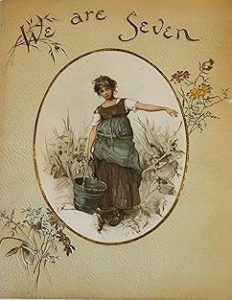
Through the narrator, Wordsworth describes the child as having a “rustic, woodland air” and being “wildly clad.” His description of her hair “thick…cluster’d round her head” imparts a wild animal image, perhaps that of a lion, then he softens this image by placing common domestic pursuits of knitting and sewing in her hands. But the stranger doesn’t see this image, only the physical one before him. “…the girl must be made to feel that ‘we’ are less than seven. To tame her wild will, the man must make her recognize a gap in her own consciousness” (Russett 356). If he cannot convince her of the error of her logic, then perhaps he can bully her into changing her perspective, much as a wild animal can be caught, caged and crippled into submission. However, just as wild animals function by instinct, so too, the child’s natural reactions are not based on cognitive thinking, but instinct. The stranger is “throwing words away” when he tries to persuade her, for her level of consciousness is not as developed as is his. “…the poet fails to bully a child into adopting an adult vocabulary. The little girl stubbornly refuses to count her family as irretrievably diminished by the loss of the dead brother and sister whom she still loves” (Pirie 154). This reduces the deadlock to a matter of semantics.
The child acknowledges the death of Jane and even brings God into the picture by telling the stranger in line 51 that “God released her of her pain.” In line 59 she recounts to him “My brother John was forced to go” further delineating her grasp of the obvious. What she refuses to relinquish is not their physical person but their very essence. She speaks of their passing with simple, elegant words. “Wordsworth said once it was the strength of her feelings of ‘animal vivacity’ that prevented her admitting the notion of death as an adult must” (Turner 122). That will come with time and maturity, but in the meantime “…the small child cajoled by the poet sticks to its determined answer” (Ward 123). When the stranger introduces the concept of “heaven” into his argument, I find it interesting that the child does not agree with him. She exhibits no problem accepting a belief in “God,” but she shies away from the idea of “heaven.” If she goes to church regularly with her parents, as we can probably safely assume she does, it seems rather peculiar she doesn’t readily admit that her two siblings are in this mystical place where angels do God’s biding and good people, especially good little children, go when they leave this earth. The nameless little maid easily explains that two lie beneath a tree in the churchyard and that’s where she wants them to stay. Placing them in heaven is transporting them to a place she cannot go.
“The adult cannot see the green graves as concrete, tangible embodiment of life, and insists on afterlife in the cultural abstraction of heaven” (Bernstein 342). The child is lonely and finds comfort in spending time with her sister and brother, the only two siblings who remain at home, even though her contact with them is limited to a one-way conversation by their graves. If she puts them in “heaven” she loses all control over their whereabouts and this is a frightening prospect. By allowing them to “dwell near” her cottage she is, unknowingly, transubstantiating them from physical flesh and blood into spiritual beings and this takes time. She assumes a healthy attitude towards their deaths, not by pretending they are still alive but by accepting they are gone. She protects her heart the only way she knows – by reassuring herself “we are seven” and no stranger is going to interfere with this notion no matter how eloquently he argues his point. The little maid embodies “…the perseverance of an individual” (Hartman 144) and it is this dogged perseverance and loyalty to her own perceptions which nourish and strengthen her to accept the unacceptable.
“‘We Are Seven’ poses the question of how to quantify loss and whether or not that loss can be given a presence and value in language” (Keegan 17). Obviously, the loss of her siblings eludes measurement for the child. They had more than numerical value when alive and she does not intend to devalue them in death by subtracting them from the family as if mere numbers could define the invisible boundaries which create bonds of love within families. “…a legalistic understanding of reason and social bonds gives way before other, more powerful, and more original bonds” (Schoenfield 120).This is a concept the stranger has yet to grasp. Part of me thinks he certainly does grasp what the child is saying, but because he is mature, he does not allow himself to agree with her. He is not the type of man who gives way to fancy. He is much too serious about that. Perhaps he does not desire to be seen as encouraging the little girl in her fantasy or he might be concerned that her concept of what’s real and what’s imagined poses dangerous consequences for her future intellectual growth, and he does not want to participate in a charade that only the foolish can imagine and accept. Therefore, his insistence on “ye are five” makes perfectly good sense to him because it absolves him from all unseemly conduct.
Critics have debated whether “We Are Seven” represents a young child with “…prescient knowledge of immortality or a child limited by ‘narrowness of experience and imperfect conceptual powers’” (Bialostosky 228). When the poem is broken down or “deconstructed” to a purely numerical degree, we must agree with the gentleman that the child is incorrect in her reasoning, and the children do, indeed, number only five. This suggests the main issue in the poem is purely numerical. But one could argue that there is something much more important happening in this brief exchange between the wise and the foolish, the old and the young and that is the question of the continuity of love and whether death severs it. In the little girl’s mind, to deny “we are seven” is the same as denying that little Jane and John ever existed, and if the stranger can ignore their existence by his refusal to count them, might he not do the same to her? Her steadfast refusal to give in might not only be a determined effort to cling to the past, but also a hedge against an uncertain future. Should she die, she does not want to be forgotten or uncounted by her remaining family members. It’s this greater concern the stranger fails to understand.
“Wordsworth connected the child of ‘We Are Seven’ with himself as he had felt in childhood when he also had been unable to conceive of death” (Moorman 22). He recalled a time when Dorothy and he lay on the grass “‘hearing the peaceful sounds of the earth and knowing that our dear friends were near’” (Moorman 22). This is what the child does in the poem. Death is not a frightening concept for her, neither is burial. She sees only the beauty in the “green graves,” the life that still comes from her siblings, as continuity between those gone before and those that remain. She relates in line 59 that “John was forced to go” almost as if Jane had requested his company, but she does not see this as selfishness on Jane’s part. Throughout most of the poem, she speaks in the present tense, lending a feeling of immediacy to the poem, and although she uses the word “forced” to denote something against her brother’s will, there is no feeling of heaviness or bitter remorse. She portrays acceptance of her loss in lighthearted, amenable terms that an adult might misinterpret as indifference or lack of understanding, but which is her manner of coping.
“We Are Seven” is “The encounter between a grown man committed to an external rational order and a young girl committed to her personal relation to her dead siblings” (Bialostosky 114) and therein lies the dilemma. The two main characters of the poem are at a cross-roads and until the child matures or the adult becomes childlike, there is very little likelihood of agreement. We can enjoy the poem for what it is – a few moments in the life of two very different people – or we can insist that one is right and one is wrong and argue for and against until the child becomes an adult and the adult dies, but the result will very likely remain the same: Two opposing views imposing themselves on each person with no definitive winner for the mindset of each remains unchanged. When, indeed, do we become “seven” or “five” or “none?” When do family members cease to be counted as part of a family and who decides – death or living relatives? I have to applaud the little girl for remaining true to her belief that death has only physical power over bodies, not spirits, for it is the spirit of each sibling that remains with the child and it is in the spirit of love that she feels their presence.